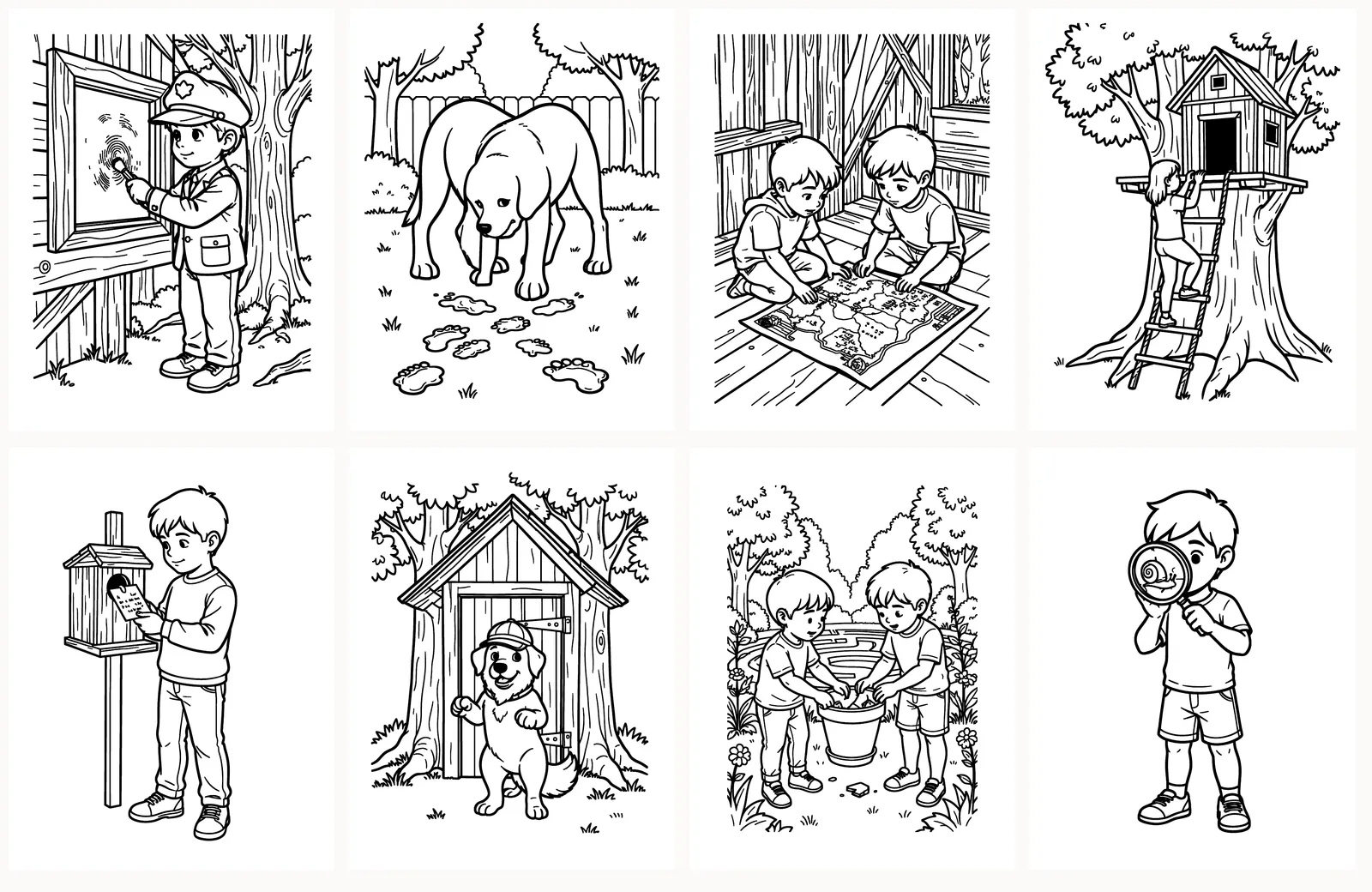
What you are looking at
Everything above comes from one real CrayonMill run: the theme typed into the wizard, the 24 topics the planner wrote around two kids and a dog solving gentle backyard mysteries, the pages as they left the 1-bit cleaner, and the preflight the download button waits for. Nothing here is retouched. The colored panels are AI examples made from the finished line art — the product itself is black-and-white line art.
This book was one of 18 books queued at the same moment, so its 319 minutes include time spent waiting behind up to 17 other books queued at once, not 319 minutes of continuous drawing on this book alone.
Two of the 24 pages in the topic list above carry a flagged badge — a boy finding a hidden note tucked inside a birdhouse ("flagged: text present"), and a dog wagging proudly with a clue in its mouth ("flagged: text present; shading"), both scenes built around a written clue where the model drew readable text on the note or the clue itself. Both were redrawn once and still came back with text, so both ship with the flagged badge above rather than a pass. Four pages also had a decorative frame or border that the 1-bit cleaner cropped away automatically.
Why this book is a good KDP candidate
A mystery brief gives kids 8–11 a reason to follow a chain of clues across 24 pages rather than 24 unconnected scenes: a map on the treehouse floor, muddy footprints, a broken flowerpot, a buried treasure chest, a missing sock in a tree branch, a puzzle solved by lantern light. Medium line weight handles that level of detail — a magnifying glass, a paw print trail, a rope pulley — without overwhelming the page, and once the two flagged pages above are redrawn again, nothing in the set carries stray text.
Why a clue-based mystery theme is more prone to text than most kids' themes
A note, a clue, a map — the very premise of a detective story keeps handing the model objects that plausibly carry writing, which is why two of the 24 pages here were flagged for text against zero for a same-audience theme with no written props, like the fox-and-rabbit forest set on this site. The pattern is the same one that shows up in the graffiti-heavy teen book elsewhere on this site: whenever a theme's core objects are conventionally covered in text, the model reaches for legible lettering more often, and the reviewer's flag-and-redraw step exists precisely to catch that before a page reaches a publisher's PDF.
Sources
Last verified 2026-09-05. Updated 2026-09-05.