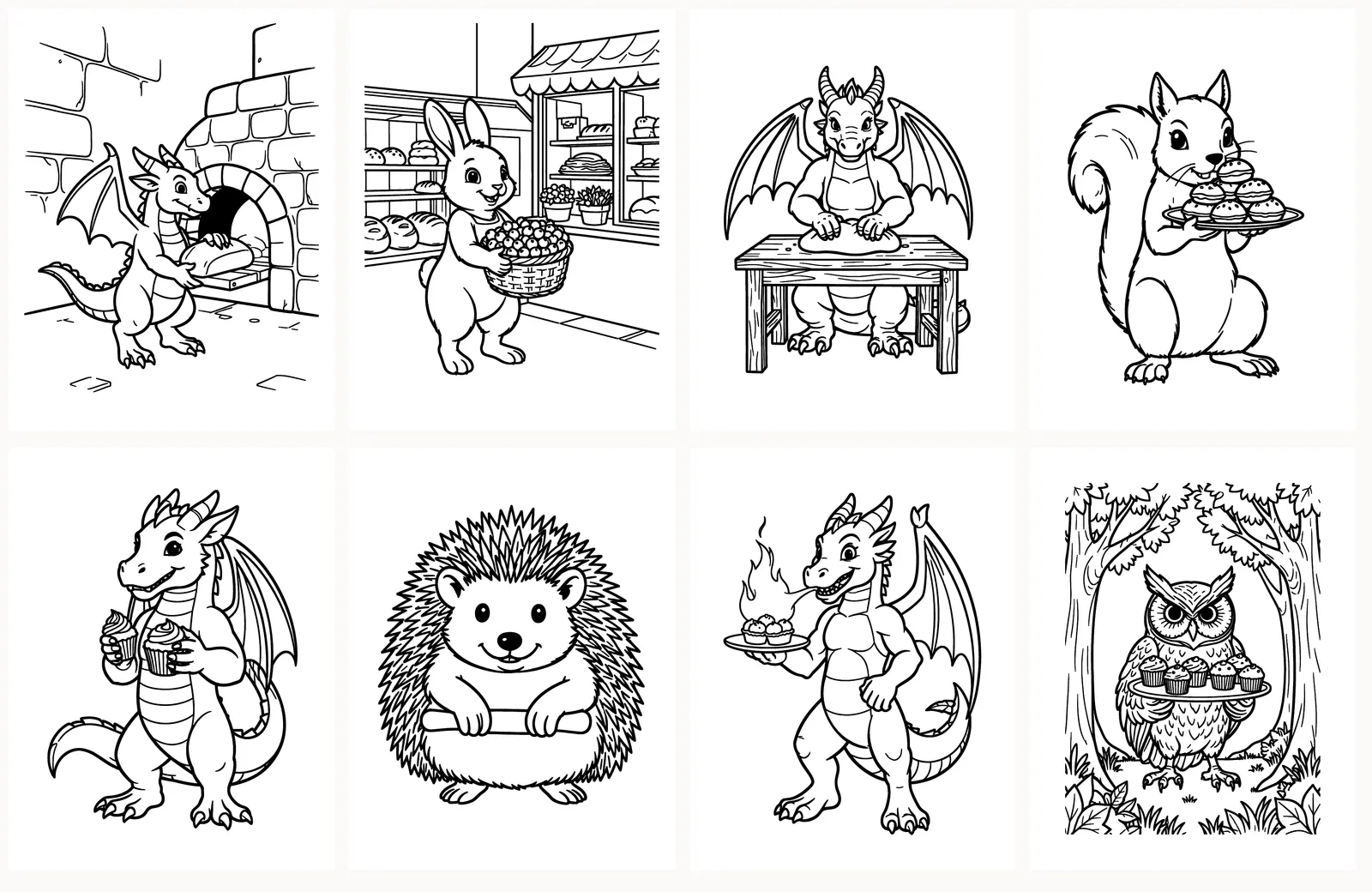
What you are looking at
Everything above comes from one real CrayonMill run: the theme typed into the wizard, the 24 topics the planner wrote around a small dragon running a forest bakery with a rotating cast of animal helpers, the pages as they left the 1-bit cleaner, and the preflight the download button waits for. Nothing here is retouched. The colored panels are AI examples made from the finished line art — the product itself is black-and-white line art.
This book was one of 18 books queued at the same moment, so its 318 minutes include time spent waiting behind up to 17 other books queued at once, not 318 minutes of continuous drawing on this book alone.
One of the 24 pages in the topic list above carries a "flagged: text present" badge — forest friends lining up outside the bakery for warm rolls, a scene where the model drew readable lettering, likely on a sign or a queue prop. It was redrawn once and still came back with that text, so it ships with the flagged badge above rather than a pass — a publisher can redraw it again with one tap. Two pages also had a decorative frame or border that the 1-bit cleaner cropped away automatically.
Why this book is a good KDP candidate
Kids 8–11 handle medium lines and a little more detail than a preschool book, and a bakery run by a single recurring dragon gives the planner a reason to vary supporting characters — a rabbit, a squirrel, a hedgehog, an owl, a raccoon, a bear, a deer — while keeping one consistent lead. Every scene stays uncrowded, and aside from the one flagged page above, nothing in the finished set needed a second pass for stray text or shading.
Why one recurring character makes a bakery theme easier to hold together
Fifteen of the 24 topics put the dragon in frame doing something bakery-specific — pulling a loaf from the oven, kneading dough, decorating cupcakes, breathing gentle fire to toast marshmallow tarts — while the other nine hand the page to a visiting forest animal on its own: a rabbit, a squirrel, a hedgehog, an owl, a family of mice, a bear, a raccoon, a deer, and a crowd of forest friends lining up outside. That structure (one lead who anchors most pages, a supporting animal who occasionally takes one solo) is a cheaper way to generate variety than inventing a new setting for every page, and it is also why food-and-craft themes like this one tend to need fewer redraws for composition than fantasy themes with less grounded subject matter — the one redraw here was for stray text, not a scene the model misunderstood.
Sources
Last verified 2026-09-05. Updated 2026-09-05.