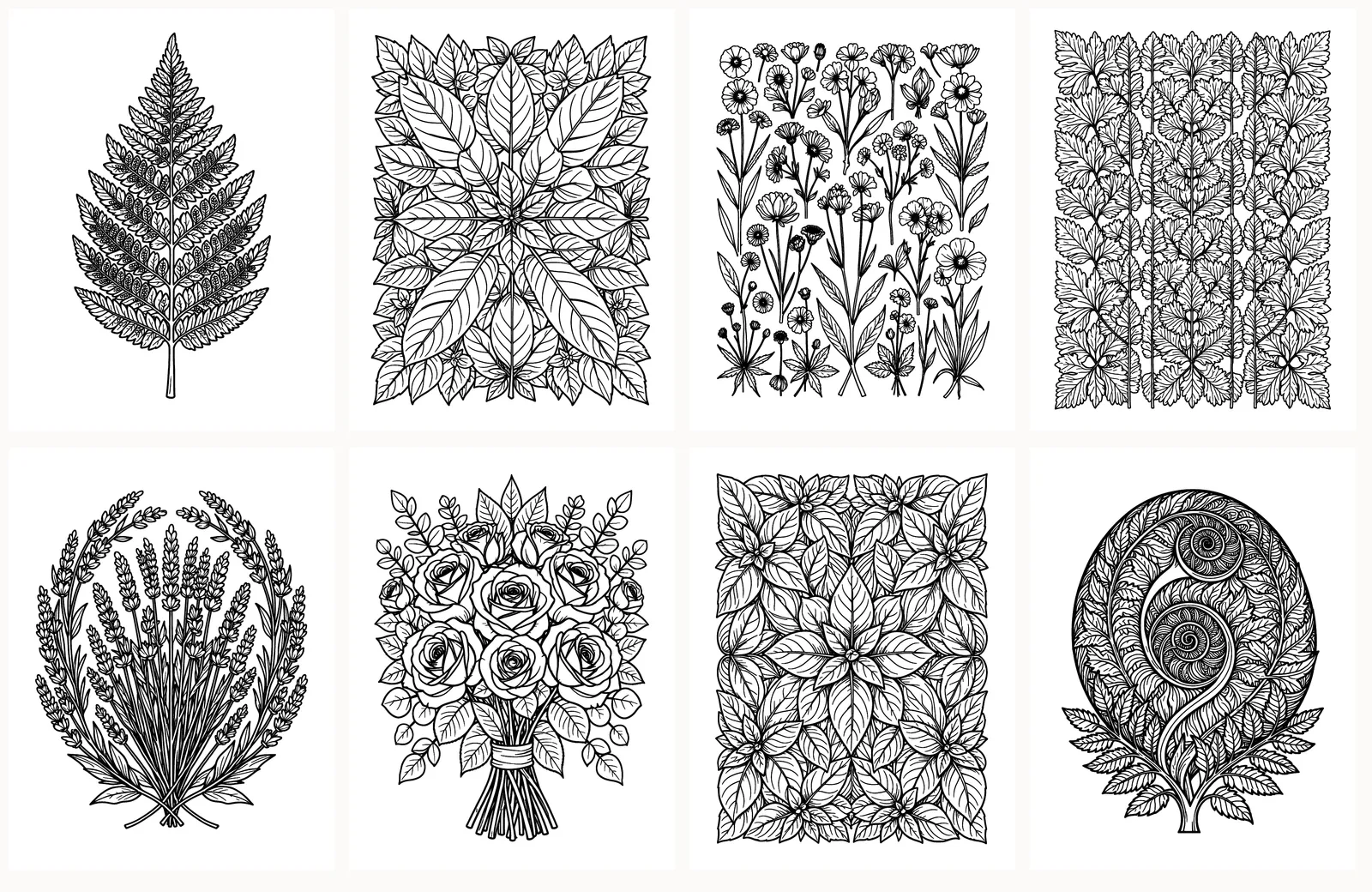
What you are looking at
Everything above comes from one real CrayonMill run: the theme typed into the wizard, the 24 topics the planner wrote around ferns, basil, and dried-flower herbarium plates, the pages as they left the 1-bit cleaner, and the preflight the download button waits for. Nothing here is retouched. The colored panels are AI examples made from the finished line art — the product itself is black-and-white line art.
This book was queued alongside four other showcase books, so its 104 minutes include time spent waiting behind four other books queued at the same moment, not 104 minutes of continuous drawing on this book alone.
Two of the 24 pages in the topic list above carry a "flagged: text present" badge — a herbarium specimen drawer and a fern page, both drawn with the small handwritten-style labels an herbarium plate normally carries. Both were redrawn once and still came back with that label text on the second pass, so both ship with the flagged badge above rather than a pass — a publisher can redraw either again with one tap. Four pages also had a decorative frame or border — a common feature on antique herbarium and album pages — that the 1-bit cleaner cropped away automatically.
Why this book is a good KDP candidate
Adults color for the pattern and the density, not to identify a single object, so a herbarium theme suits fine lines and repeating, symmetrical compositions: a tessellating clover grid, a radial fern arrangement, a wreath of pressed thyme and rosemary. Once the two flagged pages above are redrawn again, the set has no stray labeling left — the one thing that specifically threatens a botanical-specimen theme, since real herbarium sheets are labeled by convention and the model draws toward that convention.
Why herbarium pages suit fine lines
A fern frond's sori texture, a stem's vein pattern, a tessellated leaf grid — these only read as botanical illustration at fine line weight; drawn bold or extra-bold, the same subjects would collapse into shapeless blobs with no detail left to color. The topic list above leans on symmetry and repetition (a radial pattern, a tiled grid, a wreath, a mandala) rather than narrative, which is what an adult coloring audience expects from a botanical theme and what a bold toddler-style line simply cannot deliver. That is also why this theme, more than any of the others on this site, produced pages with subject counts as high as nine repeating elements on a single page — density is the point, not a side effect.
Sources
Last verified 2026-09-05. Updated 2026-09-05.