What you are looking at
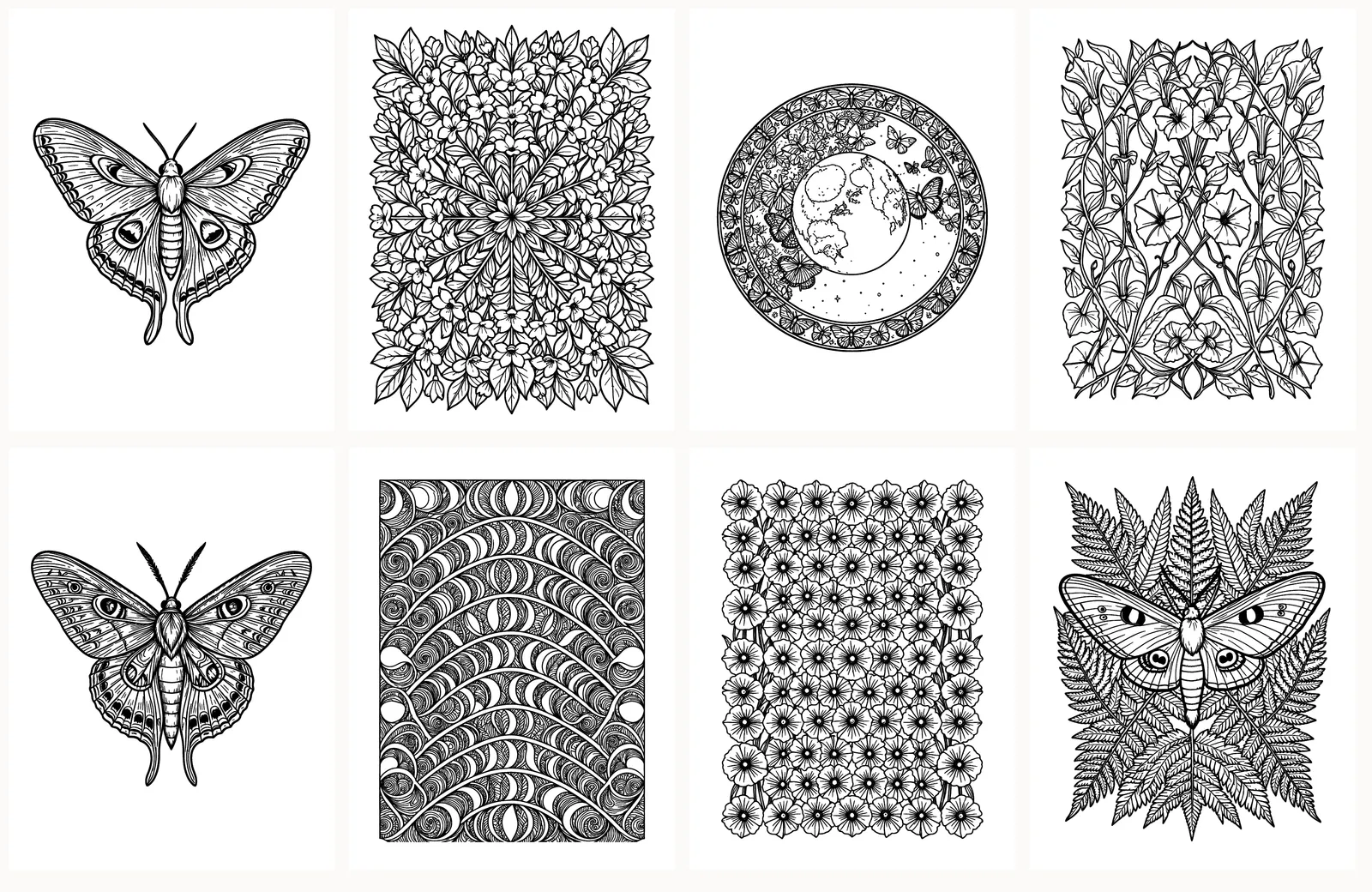
Everything above comes from one real CrayonMill run: the theme typed into the wizard, the 24 topics the planner wrote around moths, moon phases, and pressed night-blooming flowers, the pages as they left the 1-bit cleaner, and the preflight the download button waits for. Nothing here is retouched. The colored panels are AI examples made from the finished line art — the product itself is black-and-white line art.
This book was produced in a smaller queue as a pair with Tide Pool Studies, after the site's main batch of 18 books, so its 56 minutes include a little time spent waiting in that shared queue rather than 56 minutes of continuous drawing alone.
One of the 24 pages in the topic list above carries a "flagged: text present; frame border" badge: a moon-phase calendar ring encircling a resting moth, where the calendar convention pulled the model toward lettering the phase names around the ring instead of leaving plain dial marks. It was redrawn once and still came back with that text, so it ships with the flagged badge above rather than a pass. Four pages also had a decorative frame or border that the 1-bit cleaner cropped away automatically — moon-phase wheels and specimen borders are naturally frame-shaped subjects.
Like Tide Pool Studies, this is the third attempt at this theme. The first two runs were rejected before reaching this page: several pages came back as moth–human hybrids with human legs or torsos, the same failure mode that blocked the tide pool book. The planner now writes moth and flower topics as specimens and repeating patterns rather than "studies of," and the reviewer fails any unexpected human figure outright. This run passed cleanly under those rules, aside from the one calendar-ring page above.
Why this book is a good KDP candidate
Adults color for pattern and density rather than a single obvious object, so a herbarium-and-moon theme suits fine lines and symmetrical, repeating compositions: mirrored wing engravings on a luna moth, a ring of crescent moon phases, a grid of pressed evening primrose blossoms. Several pages here carry a subject count of five or more repeating elements — moths circling a crescent moon, moon phases orbiting a central specimen — which is exactly the density this audience colors for.
Why a calendar ring is the one page this theme could not avoid
A moon-phase wheel is, by convention, a labeled instrument: real calendar rings carry phase names or dates around their edge, so a model asked to draw one reaches for that lettering the same way a compass rose reaches for cardinal-direction letters or a graffiti wall reaches for spray-paint text elsewhere on this site. Every other moon-phase page in this book avoided the same trap by staying purely decorative — an arc of crescents, an orbit of phases around a moth — while this one page specifically framed the moon as a labeled calendar, which is the detail that pulled it into flagged territory.
Sources
Last verified 2026-09-06. Updated 2026-09-06.